

How to Troubleshoot RV Battery Draining While Parked
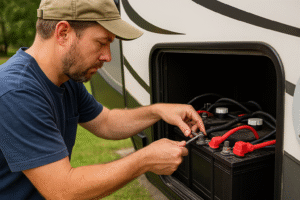
Few things are more frustrating for RVers than discovering their battery is dead—even when the RV has been sitting still for days. At Meadowlark Shores RV Resort, many guests rely on their RV batteries for lighting, slides, jacks, refrigerators, and other 12-volt systems. When a battery drains unexpectedly while parked, the cause is often simple but not always obvious. Understanding why it happens helps you fix the issue quickly and extend your battery’s lifespan.
The most common cause of battery drain is parasitic loads—small electrical components that continuously draw power even when the RV is not in active use. These include CO detectors, propane leak detectors, radio memory, control boards on refrigerators and furnaces, and even some LED lights with built-in sensors. These systems are designed to stay on, but over days or weeks, they slowly discharge your battery.
Another frequent culprit is the RV refrigerator, especially when running on propane. Even in gas mode, the fridge still uses the 12-volt system to power its control board and cooling fans. If the battery is weak or aging, even this small draw can drain it quickly. Many RVers mistake this for a battery “going bad” when the real issue is continuous low-amp demand.
Battery age and condition play a major role. Lead-acid batteries typically last three to five years in Florida’s heat. If the battery no longer holds a full charge, it may discharge rapidly even with minimal loads. Corroded terminals, loose connections, or failing cells reduce capacity and make the battery appear to drain faster than it truly is.
Temperature is another factor. Hot Florida weather causes batteries to self-discharge more quickly. Elevated temperatures also accelerate internal corrosion and water loss in flooded lead-acid batteries. At Meadowlark Shores, where rigs sit in the sun for long stretches, battery performance can decline faster than in cooler climates.
Your converter could also be part of the issue. If the converter isn’t charging the battery properly—or if it charges too slowly—the battery may never reach full capacity. A weak converter, blown fuse, or poor shore-power connection can leave the battery relying solely on stored energy instead of receiving steady charge from the electrical pedestal.
Some RVs have systems that remain powered even when you think everything is off. Motion lights, TV boosters, aftermarket alarms, hydraulic leveling systems, onboard Wi-Fi routers, and inverters can all draw power silently. An inverter left on—even with no appliances connected—can drain a battery overnight.
Solar charge controllers can also cause unexpected drain. In older or cheaper systems, reverse current can flow back into the panels at night if a blocking diode is faulty. This trickle drain is small but continuous, and over several nights it can leave your battery weak or flat.
A failing battery disconnect switch may be the reason your battery keeps draining even when you think it’s disconnected. If the switch is worn out or wired incorrectly, it may still allow small amounts of current to pass through. Checking the switch position and verifying continuity can quickly rule out this issue.
Water pumps and faulty switches sometimes cause hidden battery drain. A small leak in the system can cause the pump to cycle occasionally without you noticing. Likewise, a stuck relay or shorted switch on awnings, slides, or jacks can pull power continuously until the battery dies.
If you have a multimeter, isolating the problem becomes easier. By removing fuses one at a time and watching for current drop, you can identify which circuit is causing excessive draw. This targeted approach helps locate hidden parasitic loads without guesswork.
Preventing future battery drain starts with regular maintenance. Clean terminals, check electrolyte levels (if applicable), and perform periodic battery load tests. Using a smart charger or battery maintainer helps keep the battery fully charged without overcharging. Many seasonal guests at Meadowlark Shores also install solar trickle chargers or upgrade to lithium batteries for longer-lasting, maintenance-free performance.
With consistent inspection and awareness of the most common culprits, RVers can prevent unexpected battery drain and enjoy a reliable 12-volt system throughout their stay at Meadowlark Shores RV Resort. A healthy battery system means easier mornings, smoother departures, and fewer surprises while enjoying Florida’s beautiful riverfront lifestyle.
📍1880 Williams Rd, FL
For any questions or concerns please reach out to us
📞 (863) 675-0006