

Florida Crosswinds: How Aerodynamics Affect Trailer Safety
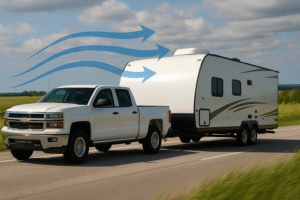
Florida’s open highways, coastal breezes, and wide prairie landscapes offer beautiful scenery, but they also bring a powerful force every RVer must understand—crosswinds. These winds create aerodynamic pressures that affect how trailers handle, sway, and respond on the road. Understanding these forces is essential for safe travel to destinations like Meadowlark Shores RV Resort.
Crosswinds act on the broad side of a trailer the way waves push against a boat. Even a light wind can create a drifting effect, while stronger gusts can cause sudden changes in direction. Tall, flat-sided RVs behave like sails, catching wind in ways that tow vehicles must constantly counteract.
Aerodynamics play a major role in how a trailer responds. The shape of the trailer, its height, and the design of its front cap all change how air flows around it. Rounded front caps reduce wind resistance, while flat-front trailers feel more force from both headwinds and side gusts.
Speed magnifies aerodynamic pressure. A 20 mph crosswind becomes far more forceful at 60 mph because the relative wind speed increases. The faster you go, the harder the wind pushes. This is why slowing down is one of the most effective tools for stabilizing a trailer in windy conditions.
Trailer weight also affects stability. Heavier trailers resist wind better than ultralight models, which can be pushed around more easily. However, even heavy trailers require proper tongue weight and balance to prevent sway when winds pick up along the water or across open farmland.
Tongue weight is critical in windy environments. If tongue weight is too light, the trailer becomes more vulnerable to sway because the hitch point lacks downward pressure. In Florida’s frequent breezy conditions, low tongue weight is one of the biggest contributors to unsafe handling.
Crosswinds are especially challenging when they hit suddenly. Bridges, overpasses, open fields, and coastal causeways can expose an RV to abrupt gusts. When leaving tree cover or tall buildings, drivers often feel a strong push as the wind hits the trailer broadside.
Tow vehicle size and wheelbase also influence aerodynamic control. Larger trucks with long wheelbases provide better stability because they resist rotational forces. Shorter wheelbase SUVs or half-ton trucks may struggle more with wind-induced sway, even with lighter trailers.
Sway control hitches help, but they are not magic. These systems reduce the severity of sway once it begins, but they cannot eliminate aerodynamic forces. A sudden gust can still push a trailer, though a good hitch will help prevent that push from turning into a dangerous oscillation.
Tire pressure also affects how trailers respond to wind. Properly inflated tires provide the firm footprint needed to resist lateral movement. Underinflated tires flex more, making the trailer feel unstable and amplifying sway in windy conditions.
Road design can intensify or minimize wind impact. A narrow two-lane road bordered by trees may feel calm, but entering a wide-open highway or coastal causeway can suddenly expose the trailer to strong gusts. Awareness of these transitions helps drivers prepare in advance.
Aerodynamics also matter when passing or being passed by large vehicles. Semi-trucks create pressure waves that push and pull on a trailer as they approach and pass. In windy conditions, these pressure changes become even more dramatic, requiring steady hands and slower speeds.
By understanding how aerodynamics and Florida crosswinds affect travel trailers, RVers can take proactive steps to stay safe. Proper loading, correct tongue weight, controlled speeds, and the right hitch setup can dramatically improve stability. With the right preparation, travelers can enjoy smooth, stress-free journeys to the riverfront beauty of Meadowlark Shores RV Resort—no matter what the wind is doing.
📍1880 Williams Rd, FL
For any questions or concerns please reach out to us
📞 (863) 675-0006