

Tow Vehicle Myths Debunked: Payload, Tongue Weight & Real-World Ratings
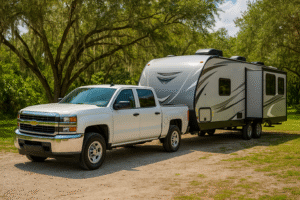
Many RV owners arrive at Meadowlark Shores RV Resort with questions about their tow vehicle’s true capabilities, especially when it comes to payload, towing capacity, and safe weight ratings. Because these numbers can be confusing, several myths continue to circulate among new and experienced RVers alike. Understanding how these ratings actually work is essential for safe travels and long-term RV performance.
A common myth is that a truck’s advertised towing capacity is the amount it can tow in any scenario. In reality, manufacturers determine this number under specific test conditions, and it does not necessarily reflect what your vehicle can handle once passengers, gear, and hitch weight are included. Real-world towing is always limited by the lowest rating on the truck.
Another misconception is that payload and towing capacity are interchangeable. Payload refers to everything added inside or on the vehicle—passengers, cargo, fuel, the hitch, and the trailer’s tongue weight. Towing capacity refers only to what the vehicle can pull. Many RVers unknowingly exceed payload before they ever come close to max towing.
Tongue weight is often overlooked, yet it’s one of the most important safety factors. A safe tongue weight typically ranges from 10–15% of the trailer’s total weight. Too low and the trailer can sway; too high and it overloads the truck’s rear axle, creating dangerous handling issues.
Some RV owners believe upgrading shocks, springs, or adding air bags increases payload. While these accessories can improve stability, they do not legally increase your Gross Vehicle Weight Rating (GVWR). Only the manufacturer can assign weight ratings, meaning your truck’s limits stay the same regardless of aftermarket changes.
Another myth is that half-ton trucks can safely tow any travel trailer under 7,000 pounds. While many half-tons are capable, tongue weight and payload are usually the limiting factors. It’s not uncommon for a 6,500-pound trailer to exceed a half-ton’s payload once loaded for travel.
RVers also sometimes assume that weight distribution hitches increase towing capacity. These hitches improve balance and reduce rear sag, but they do not change the truck’s actual ratings. They help you operate within safe limits—never above them.
A frequent misunderstanding involves Gross Combined Weight Rating (GCWR). Some believe this number is simply the truck’s weight plus the towing capacity. Instead, GCWR is the maximum allowed weight of the truck and trailer combined. This rating includes fuel, passengers, cargo, and everything you bring to your RV site at Meadowlark Shores.
Another myth suggests that if a trailer “feels stable,” it is within weight limits. Handling can be deceiving. You might not notice stress on your axles, brakes, or engine until mechanical problems appear on the highway. True safety comes from actual scale weights, not seat-of-the-pants impressions.
Some RVers assume that towing at slower speeds makes exceeding ratings safer. In truth, overweight rigs experience increased wear on brakes, transmissions, cooling systems, and tires no matter how slowly they’re driven. Heat is the enemy, and overweight towing creates heat quickly.
There is also confusion about dry weights. Many shoppers rely on a trailer’s dry weight to choose a tow vehicle, but dry weights exclude water, propane, food, gear, and upgrades. A trailer that appears towable on paper may exceed safe limits once fully loaded for a stay on the river at Meadowlark Shores RV Resort.
Finally, many believe that “real-world ratings” are just estimates. In fact, scale weights—taken at a truck stop CAT Scale—provide precise, reliable numbers. These measurements help RVers avoid overloaded axles, improve handling, protect transmissions, and extend the life of both the tow vehicle and the RV.
By understanding the truth behind these common myths, RV owners can enjoy safer towing, longer-lasting equipment, and more confident travel to destinations like Meadowlark Shores RV Resort. Proper weight management ensures smooth arrivals, stress-free journeys, and the peace of mind every RVer deserves.
📍1880 Williams Rd, FL
For any questions or concerns please reach out to us
📞 (863) 675-0006